Clinician Empowerment
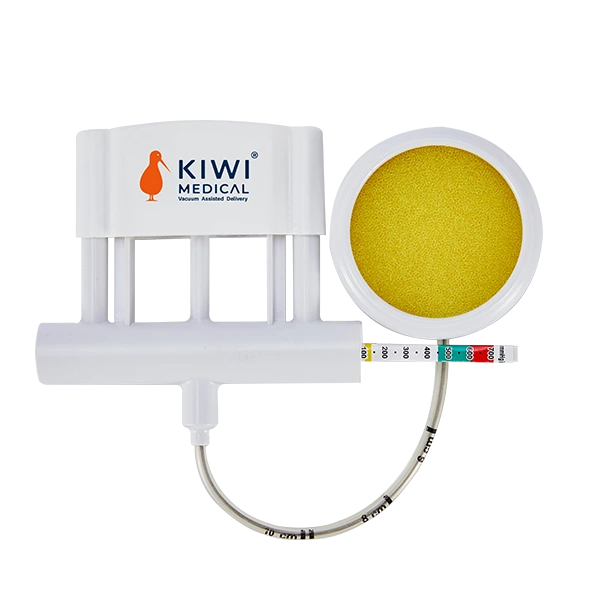
A conventional vacuum extraction system comprises three separate components: the cup, connecting tubing, and an independent electric or foot-operated vacuum pump. Negative pressure is controlled by an assistant or by the machine, and the operator can regulate it only indirectly through verbal instruction. The Kiwi , developed by Aldo Vacca in the 1990s, integrates the vacuum source into the handle itself in the form of the PalmPump. The operator can generate vacuum, maintain it, and apply traction with a single hand, leaving the other hand free to check the cup rim for entrapped soft tissue and to assess descent and rotation of the fetal head. The complete system is supplied sterile and pre-assembled for single use, requiring no assembly, external tubing, or power supply. The practical significance of this design change is that the person applying the vacuum and the person applying traction are the same individual, giving the operator direct proprioceptive feedback as to whether the current level of adhesion will withstand the traction about to be applied, rather than relying on a third party’s report. In precipitate deliveries, on understaffed night shifts, or during transfer within the labour ward, this self-sufficiency substantially reduces dependence on team coordination.
References: [10] Vacca A. Five questions about the Kiwi OmniCup™ vacuum extractor (device design rationale); [17] Kiwi OmniCup VAC-6000M Instructions for Use; [1] Groom KM, et al. BJOG 2006;113:183-189 (noting the smaller overall equipment size and the ability to measure traction force).
|
Q2. How do the low-profile cup and flexible stem of the OmniCup assist in achieving flexion-point placement? |
|
The key mechanical prerequisite for successful vacuum extraction is that the centre of the cup be placed as close as possible to the flexion point — a site on the sagittal suture approximately 3 cm anterior to the posterior fontanelle. When the cup is correctly sited, traction is transmitted along the smallest diameter of the fetal head, promoting flexion and autorotation; deflexing applications, by contrast, increase the presenting diameter and predispose to cup detachment and genital tract trauma. The pairs a 50 mm low-profile cup with a flexible traction stem. The reduced cup height allows it to be advanced along the posterior vaginal wall without obstruction by the symphysis pubis, and the stem can be angulated without compromising vacuum transmission, enabling the operator to manoeuvre the cup onto a flexion point situated deep and posteriorly in the pelvis in occipito-posterior and occipito-transverse positions. In the clinical series reported by Skehan et al. in the International Journal of Gynecology & Obstetrics (2024), flexing applications were achieved in 90% of 50 vacuum procedures, with an overall vaginal delivery rate of 98%. This design allows a single cup to be used across anterior, transverse and posterior positions References: [5] Skehan L, et al. Simplifying the use of the Kiwi vacuum. Int J Gynecol Obstet 2024 (90% flexing applications; 98% vaginal delivery rate); [10] Vacca A. Five questions about the Kiwi OmniCup™; [17] VAC-6000M Instructions for Use (cup specifications). |
|
Q3. How much time does the integrated hand pump save compared with an external vacuum pump in emergency situations? |
|
With a conventional system, the interval between the decision to proceed and the establishment of effective vacuum involves retrieving the instrument, connecting the tubing, powering up or priming the pump, checking for leaks, and raising the pressure in stages. This typically takes several minutes and depends heavily on the assistant’s familiarity with the equipment. The Kiwi is supplied pre-assembled for single use; the cup can be applied as soon as the pack is opened, and approximately a dozen compressions of the PalmPump generate a working vacuum of 0.8 kg/cm² (approximately 600 mmHg) without any external device. Where fetal heart rate abnormalities in the second stage require delivery to be completed within minutes, this saved preparation time has genuine clinical value. The device is also independent of mains power and tubing, and can therefore be used outside the operating theatre, in the delivery room, during transfer, and in facilities without a reliable electricity supply. The description of the system as smaller in overall size and portable (Groom et al., BJOG 2006) reflects this characteristic. Importantly, a shorter preparation time must never be taken to justify omitting formal assessment of the indication, the fetal head position and station, or bladder emptying. References: [1] Groom KM, et al. BJOG 2006;113:183-189 (smaller overall equipment size and portability); [17] VAC-6000M Instructions for Use (method of vacuum generation and working pressure). Note: the magnitude of time saved has not been quantified in any comparative study; this is a mechanistic inference. |
|
Q4. What is the clinical significance of the Traction Force Indicator (TFI)? |
|
Complications of vacuum extraction such as cephalohaematoma and subgaleal haemorrhage are directly related to excessive traction force and prolonged application. In conventional practice, however, the force applied is known only through the operator’s subjective impression: it cannot be quantified, taught, or documented. The Kiwi variant of the OmniCup incorporates a mechanical traction force indicator on the stem, allowing the operator to read the force being applied in real time during traction. Published device evaluation has shown the overall measurement error of the indicator to be very small and clinically acceptable, and the investigators proposed that injuries such as cephalohaematoma and subgaleal haemorrhage may be minimised if recommended safe traction limits are not exceeded. The value of this feature operates at three levels: intraoperatively, it provides an objective threshold prompting reconsideration of whether to continue; postoperatively, it permits an objective entry in the clinical record; and in training, it converts the notion of an appropriate force from tacit experience into a referable numerical value. References: [9] Vacuum-assisted delivery: an analysis of traction force and maternal and neonatal outcomes. PMID 16638034 (very small measurement error; injuries may be minimised if recommended traction limits are not exceeded); [10] Vacca A. Five questions about the Kiwi OmniCup™; [17] VAC-6000MT product literature. Q5. How does the device support adherence to stopping rules such as “three pulls, three detachments, twenty minutes”? National guidelines generally specify stopping criteria for vacuum extraction, commonly expressed as: abandon the procedure if there is no descent after three effective pulls, if three cup detachments occur, or if the total procedure time exceeds approximately twenty minutes. Applying these rules presupposes that each parameter can be counted and judged unambiguously. Because vacuum on the Kiwi is controlled by the operator, the beginning and end of each pull are clearly defined; detachment is an audible and palpable event; and, with the traction force indicator, the operator can also judge whether a given pull constituted an effective pull, avoiding the miscounting of several ineffective light pulls as one. Whether re-application and re-establishment of vacuum after a detachment is feasible likewise remains entirely within the operator’s control, reducing prolongation of the procedure while awaiting an assistant to restore vacuum. It must be emphasised that the instrument only facilitates compliance; adherence itself depends on institutional protocol and operator discipline. The higher detachment rate reported for the Kiwi (Groom 2006: mean 0.68 versus 0.28 detachments; 44% versus 18% with at least one detachment) makes rigorous counting of detachments particularly important with this device. References: [1] Groom KM, et al. BJOG 2006;113:183-189 (mean 0.68 vs 0.28 detachments; 44% vs 18% with ≥1 detachment); [9] PMID 16638034 (quantification of traction force). Note: the “three pulls / three detachments / twenty minutes” formulation derives from RCOG Green-top Guideline No. 26 and related ACOG guidance, not from the device studies cited here. Q6. Are the existing randomised controlled trials consistent regarding success rates, and how should they be interpreted? It must be stated frankly that the randomised evidence is not consistent, and that parts of it are unfavourable to the Kiwi. In the prospective randomised controlled trial by Groom et al. (BJOG 2006), the failure rate with the instrument of first choice was 30.1% for the Kiwi versus 19.2% for conventional ventouse cups. Attilakos et al. (2005) reported failure rates of 34% versus 21%, with significantly more subsequent forceps deliveries in the Kiwi arm (22% versus 10%). Both trials, however, found no between-group difference in the rate of eventual vaginal delivery, in caesarean section rate (9.4% versus 8.2%), or in the incidence of severe maternal or serious neonatal injury. A further study reported successful completion of birth in 94% versus 99% of cases. Two considerations bear on interpretation: the early trials were largely conducted while operators were on the learning curve for a new device and had not yet mastered flexion-point application, whereas a clinical series reported after the technique had matured (Skehan 2024) achieved a 98% success rate. The reasonable conclusion is that the performance of the Kiwi is more dependent on operator technique than that of conventional cups, and that structured training is a precondition for realising its potential. References: [1] Groom KM, et al. BJOG 2006;113:183-189 (first-instrument failure 30.1% vs 19.2%); [2] Attilakos G, et al. PMID 16225571 (failure 34% vs 21%; forceps 22% vs 10%; caesarean 9.4% vs 8.2%); [3] PMID 24741125 (birth completed in 94% vs 99%); [5] Skehan L, et al. IJGO 2024 (98% success); [8] J Matern Fetal Neonatal Med 2017 (retrospective comparison of handheld and conventional systems). Q7. How does the device perform in malpositions such as occipito-posterior and occipito-transverse? This is both the most discussed and the most delicate application of the Kiwi. On the favourable side, Skehan et al. (2024) reported autorotation of the fetal head in 31 (97%) of 32 rotational vacuum procedures, attributing this to the flexible stem, which permits flexion-point application even in occipito-transverse and occipito-posterior positions. However, Schreiber et al. (Int J Gynecol Obstet 2023) found that, with the Kiwi , rates of anal sphincter injury and of neonatal subgaleal haematoma were both higher in occipito-posterior than in occipito-anterior positions. The two findings are not contradictory: the device makes correct application in malposition mechanically feasible, but delivery from an occipito-posterior position is inherently more difficult and carries a higher complication risk than from an occipito-anterior position, and that intrinsic risk is not abolished by instrument design. The clinical corollary is that, in malposition, fetal head position and station should be confirmed by ultrasound before the decision to proceed, and the risks should be fully disclosed to the woman and her family. A universal cup must not be construed as conferring exemption from the risks of a difficult malposition. References: [5] Skehan L, et al. Int J Gynecol Obstet 2024 (autorotation in 31/32, 97%, of rotational procedures); [4] Schreiber H, et al. Head position and vacuum-assisted delivery using the Kiwi Omnicup. Int J Gynecol Obstet 2023 (higher rates of anal sphincter injury and subgaleal haematoma in occipito-posterior positions). Q8. What are the learning-curve characteristics of this device for junior doctors and trainees? The high technical threshold of forceps delivery and the diminishing opportunities for supervised practice are problems common to obstetric services worldwide. Vacuum extraction is comparatively easier to acquire and has consequently become the principal vehicle for training in operative vaginal birth. The teaching advantages of the Kiwi include: self-sufficiency, so that a trainee can complete the entire procedure on a manikin without an assistant; operator-generated vacuum, which conveys the relationship between vacuum and traction directly; visualisation of traction force in TFI-equipped models, allowing the instructor to correct excessive force — the commonest error — in real time; and single-use packaging, which facilitates use in volume during skills training. The disadvantages are equally clear: as noted in Q7, the higher failure and detachment rates in the early randomised trials indicate that, in the absence of mastery of flexion-point application, this device is no more forgiving than a conventional cup. Training should therefore concentrate on four elements — determination of fetal head position (including ultrasound confirmation), flexion-point application, direction of traction, and the timing of abandonment — rather than on manipulation of the device itself. References: [1] Groom KM, et al. BJOG 2006 (failure and detachment rates during the learning curve); [2] Attilakos G, et al. PMID 16225571; [9] PMID 16638034 (visualisation of traction force); [14] Reintroducing vacuum extraction in primary health care facilities: a case study from Tanzania. BMC Pregnancy Childbirth 2018 (competency-based training using anatomical models). Q9. What is the role of the device in assisting delivery of the fetal head at caesarean section? In addition to operative vaginal birth, the manufacturer supplies the Kiwi Cup for use at caesarean section. Difficulty delivering the fetal head at caesarean — particularly after arrest in the second stage with the head deeply impacted in the pelvis, or conversely with a high floating head — is an important source of intraoperative haemorrhage, extension of the uterine incision, bladder and ureteric injury, and neonatal trauma. Conventional management relies on the operator’s manual technique or on an assistant pushing the head up vaginally. Applying a vacuum cup through the uterine incision provides a controlled traction point where the head is high, reducing manual traction and excessive stretching of the incision. It must be stated clearly that the evidence base for this application is weaker than that for operative vaginal birth: available material consists largely of manufacturer technical literature and small experiential series, without support from high-quality randomised trials. This indication should therefore be presented with caution and used strictly within the scope stated in the instructions for use. Q10. From the standpoint of operator posture and ergonomics, what are the advantages of the integrated hand pump? During operative vaginal birth the operator must often maintain a crouched, forward-leaning posture in a confined space while coordinating several actions simultaneously. With a conventional system the operator holds the cup with one hand and applies traction with the other while repeatedly instructing an assistant to raise or lower the vacuum, with attention alternating between controlling the equipment and assessing progress. The PalmPump design allows generation and maintenance of vacuum and the application of traction to be performed with a single hand, leaving the other hand available throughout for vaginal assessment: confirming that no cervix or vaginal wall is entrapped beneath the cup rim, appreciating descent and rotation of the head, and protecting the perineum where required. This division of labour means the operator retains direct tactile information about conditions in the birth canal throughout, without interrupting assessment in order to operate the device. The system is also light and free of external tubing, reducing the risk of tubing entanglement, inadvertent disconnection, and contamination of the sterile field. These represent improvements in the operating experience; in the absence of controlled studies using quantified ergonomic endpoints, they should be presented as design characteristics rather than as outcome claims. References: [10] Vacca A. Five questions about the Kiwi OmniCup™; [17] VAC-6000M Instructions for Use. Note: this item describes design characteristics; no controlled study using quantified ergonomic endpoints is available. |
Patient Advantages
|
Q1. Compared with caesarean section, what is the principal benefit to the woman of a successful vacuum-assisted birth? |
|
Where the second stage arrests or fetal compromise occurs, a safely completed operative vaginal birth spares the woman an abdominal operation. Caesarean section entails abdominal and uterine incisions, anaesthetic risk, greater intraoperative blood loss, more pronounced postoperative pain, longer hospital stay, delayed mobilisation and initiation of breastfeeding, and the risks of wound infection, venous thromboembolism and adhesion formation. More important still are the longer-term consequences: a uterine scar substantially increases the risk of placenta praevia, placenta accreta spectrum and uterine rupture in subsequent pregnancies, and constrains the choice of birth mode thereafter. When caesarean section is performed after arrest in the second stage, the head is frequently deeply impacted, and the risks of extension of the uterine incision, bladder injury and haemorrhage arising from difficult delivery of the head are appreciably higher than at elective caesarean. Where the indication is clear and conditions are appropriate, therefore, the value to the woman of a successful operative vaginal birth lies not only in the current delivery but in the preservation of an unscarred uterus. References: [11] Allen VM, et al. Obstet Gynecol 2006. PMID 16946214; [12] Cost-Benefit and Outcome Comparison: Operative Vaginal and Cesarean Delivery. IntechOpen; [16] PMC7227301 (Nigeria). Note: the long-term obstetric risks of a scarred uterus represent established consensus in obstetrics and are not a direct finding of the device studies cited here. |
|
Q2. How does the Kiwi compare with metal cups with respect to maternal soft tissue trauma? |
|
Several comparative studies indicate that cup material and profile have a real effect on maternal genital tract trauma. A study comparing the Kiwi , the polyethylene–silastic cup and the conventional Malmström metal cup found maternal soft tissue injury to be significantly higher with metal cups than with the Kiwi , the authors concluding that both the polyethylene–silastic cup and the Kiwi OmniCup were superior to the Malmström cup in reducing maternal birth canal injury. The mechanism is readily understood: a metal cup has a rigid rim and high profile, is more liable to abrade the vaginal wall and cervix during application and traction, and by virtue of its bulk compresses soft tissue more markedly along the path of insertion. The Kiwi, by contrast, is of engineering plastic with a low profile and blunt rim, and produces less mechanical irritation on insertion. It should be noted that such comparisons derive largely from single-centre studies with varying sample sizes and operator experience; the direction of effect is consistent but the precision of the effect size is limited. Moreover, no between-group difference in severe maternal trauma was found in randomised trials such as Groom 2006. References: [3] PMID 24741125 (significantly higher maternal soft tissue injury with metal cups); [7] Kiwi Omnicup versus Malmstrom metal cup in vacuum assisted delivery: A randomized comparative trial; [1] Groom KM, et al. BJOG 2006 (no between-group difference in severe maternal trauma). |
|
Q3. How should the risk of perineal and anal sphincter injury be regarded when using this device? |
|
Any operative vaginal birth increases the risk of severe perineal tearing and obstetric anal sphincter injury (OASI). This is an intrinsic cost of instrumental delivery rather than a property of any particular brand of device. Vacuum extraction carries a lower overall risk of perineal trauma than forceps, which is among the reasons most guidelines favour the vacuum where both are feasible. With specific reference to the Kiwi , Schreiber et al. (2023) found the rate of anal sphincter injury to be higher in occipito-posterior than in occipito-anterior positions, indicating that fetal head position is a more important determinant of risk than the choice of device. Key measures for reducing this risk include accurate determination of fetal head position with preferential selection of favourable cases, correct flexion-point application to minimise the presenting diameter, control of the rate of traction, performance or direct supervision by an experienced operator, and appropriate manual perineal protection. The risk should be disclosed honestly to the woman before the procedure, rather than the advantages of the device alone being emphasised. References: [4] Schreiber H, et al. Int J Gynecol Obstet 2023 (higher anal sphincter injury rate in occipito-posterior positions); [1] Groom KM, et al. BJOG 2006 (no between-group difference in severe maternal trauma). Note: the comparison of perineal trauma risk between vacuum and forceps derives from RCOG/ACOG guidance and related systematic reviews, not from any single study cited here. |
|
Q4. Is there a difference in neonatal pain response between plastic and metal cups? |
||
|
A secondary observational analysis conducted at three Swiss tertiary hospitals assessed neonatal pain response immediately after birth using the EDIN scale (Échelle Douleur Inconfort Nouveau-Né). Infants delivered with a plastic cup (Kiwi ) showed lower pain scores than those delivered with a metal cup ventouse; that is, the neonatal pain response was reduced in the Kiwi group. The study was published in BMC Pregnancy and Childbirth. A plausible explanation is that differences in cup material and rim design produce different distributions of compressive and shear stress on the scalp. Interpretation should remain cautious: the study was a secondary observational analysis rather than a randomised controlled trial, residual confounding cannot be excluded, and the magnitude of the between-group difference was a slight reduction rather than a clinically decisive one. Nonetheless, against a background of increasing attention to neonatal pain, the direction of this evidence is of relevance to device selection and indicates that mode of birth has a measurable influence on early neonatal discomfort. References: [6] Decreased neonatal pain response after vaginal-operative delivery with Kiwi OmniCup versus metal ventouse. BMC Pregnancy and Childbirth 2017;17:41 (three Swiss tertiary hospitals; EDIN scale; secondary observational analysis). Note: secondary observational analysis, not a randomised trial; the difference was a slight reduction.
|
Health Economics
|
Q1. In terms of direct delivery costs, how large is the gap between operative vaginal birth and caesarean section? |
|
Published cost analyses point in a reasonably consistent direction. A study of the economic implications of mode of delivery reported the direct cost of caesarean section in labour at approximately US$2,137, compared with approximately US$1,594 for assisted vaginal delivery — about one third higher. When costs cumulative to the index birth are included (readmission, management of complications, and the consequences for subsequent pregnancies), the cumulative cost of assisted vaginal delivery at first birth was approximately US$7,288 versus approximately US$9,524 for caesarean section in labour, a difference of some US$2,200. The differential arises principally from operating theatre occupancy and staffing, anaesthesia, longer inpatient stay, postoperative analgesia and antibiotic use, and the management of surgical complications. It should be noted that these figures derive from a particular national payment system and period, and the absolute amounts cannot be transferred directly to other health systems. The relative relationship — that caesarean section in labour costs substantially more than operative vaginal birth — is nonetheless stable in direction across studies and is of cross-system relevance. References: [11] Allen VM, et al. Cumulative economic implications of initial method of delivery. Obstet Gynecol 2006. PMID 16946214 (caesarean in labour US$2,137 vs assisted vaginal US$1,594; cumulative US$9,524 vs US$7,288); [12] IntechOpen cost-benefit comparison. Note: figures derive from the US payment system; absolute values are not directly transferable. |
|
Q2. Given that the unit price exceeds that of a reusable extractor, how can the device still be economical? |
|
The purchase price of a single-use device does exceed the per-use amortised cost of a reusable metal cup, and this is the commonest objection. A complete cost comparison, however, must incorporate the whole-life costs of the reusable option: staff time for cleaning and disinfection; enzymatic detergents and sterilisation consumables; energy, depreciation and maintenance of sterilising equipment; the quality-control costs of biological indicators and traceability documentation; replacement expenditure as instruments age; and the purchase, repair and calibration of a separate vacuum pump. Items that are real but difficult to monetise should also be counted: availability gaps arising from slow instrument turnaround, and the infection and medico-legal exposure created by reprocessing failure. Once these are included, the gap between the two options narrows appreciably, and in institutions with high labour costs or low reprocessing volumes (and hence high unit costs) it may even reverse. It should be stated candidly that no high-quality health economic study has directly compared the full costs of single-use and reusable vacuum extractors; the foregoing is an analytical framework at the level of cost composition rather than an empirical finding. References: Note: this item has no direct empirical support. No health economic study comparing the whole-life costs of single-use and reusable vacuum extractors is available. It is offered as a framework of cost composition for institutions building local costing models. For equipment and reprocessing requirements see [17] VAC-6000M Instructions for Use. |
|
Q3. How is the health economic value of avoiding one unnecessary caesarean section realised? |
|
The value substantially exceeds the cost differential of the index birth and must be assessed longitudinally. A uterine scar increases the incidence of placenta praevia, placenta accreta spectrum and uterine rupture in subsequent pregnancies; management of placenta accreta frequently involves massive transfusion, hysterectomy, intensive care and a multidisciplinary surgical team, with a single case costing tens of times more than a routine birth. A first caesarean also greatly increases the probability of repeat caesarean in subsequent pregnancies, producing a cumulative cost effect. Women delivered by caesarean have longer inpatient stays, higher postnatal readmission rates, and greater expenditure on the management of wound infection and venous thromboembolism. What one successful operative vaginal birth saves is therefore not merely the several hundred to several thousand units of currency of the index admission, but the reduction in expected expenditure across that woman’s entire reproductive career from avoiding a scarred uterus. This reasoning is among the economic foundations for the adoption of the nulliparous term singleton vertex (NTSV) caesarean rate as a core quality indicator internationally. References: [11] Allen VM, et al. PMID 16946214 (cumulative cost perspective); [12] IntechOpen cost-benefit comparison. Note: the association between number of scars and placenta praevia/accreta derives from obstetric epidemiology, and the NTSV caesarean rate as a core quality indicator derives from national quality improvement programmes; neither is a finding of the device studies cited here. |
|
Q4. What is the impact on delivery suite beds and operating theatre resources? |
||||
|
The resource bottleneck in obstetrics is generally not consumables but theatre capacity and staffing. A caesarean section in labour occupies an operating theatre, an anaesthetist, scrub and circulating nurses and neonatal resuscitation personnel, typically for one to two hours, and displaces elective scheduling while reducing responsiveness to further emergency caesareans. Operative vaginal birth is performed in the delivery room, occupies no theatre, requires fewer personnel, and is generally completed within tens of minutes. The Kiwi system’s independence from mains power and an external pump further reduces its tie to a specific room or equipment, so that in principle assisted birth can be undertaken in any delivery room. In high-volume tertiary centres with constrained theatre capacity, the economic value of this triage effect — keeping safely manageable cases in the delivery suite — frequently exceeds the cost differential of the consumable itself. In addition, mean length of stay is higher after caesarean than after vaginal birth, so that reducing unnecessary caesareans also directly improves bed turnover. References: [11] Allen VM, et al. PMID 16946214 (differences in length of stay and resource use); [12] IntechOpen cost-benefit comparison; [17] VAC-6000M Instructions for Use (independence from mains power and external pump). Note: the specific economic effect of theatre triage must be modelled locally by each institution. Q5. Where does the health economic value of this device lie in low- and middle-income or resource-limited settings? In these settings obstructed and prolonged labour is an important cause of maternal death: an estimated 4–13% of maternal deaths in Africa, Asia, Latin America and the Caribbean are attributed to complications of prolonged and obstructed labour, while instrumental vaginal delivery — an evidence-based intervention — remains persistently underused. One reason is that many primary-level facilities lack the conditions for safe caesarean section (theatre, anaesthesia, transfusion, postoperative monitoring), so that obstructed labour can be managed only by referral, and referral delay translates directly into death and disability, including obstetric fistula. The Kiwi system’s independence from electricity and external equipment, its ready-to-use packaging, and its freedom from any reprocessing requirement correspond closely to the constraints of such environments. Implementation studies of the reintroduction of vacuum extraction in Tete Province, Mozambique, in primary care facilities in Tanzania, and at Mulago Hospital, Uganda, indicate that combined interventions of training, accreditation, audit and feedback improve the delivery of emergency obstetric care, accompanied by reductions in institutional maternal mortality and stillbirth rates. In this context the economic significance extends beyond cost saving: it constitutes a highly cost-effective intervention purchasing life-years at very low cost. References: [13] Improving emergency obstetric care and reversing the underutilisation of vacuum extraction: Tete Province, Mozambique. PMC6020342 (4–13% of maternal deaths from prolonged/obstructed labour; training, accreditation, audit and feedback); [14] Reintroducing vacuum extraction in primary health care facilities: Tanzania. BMC Pregnancy Childbirth 2018; [15] Audit of a program to increase the use of vacuum extraction in Mulago Hospital, Uganda. BMC Pregnancy Childbirth 2016; [16] Nigeria: perinatal outcomes of second-stage caesarean versus vacuum extraction. PMC7227301. Q6. In terms of training costs, what economic advantages does vacuum extraction have over forceps? Forceps delivery has a high technical threshold and a long learning curve, requiring extensive supervised practice on real births to achieve proficiency. As caesarean rates rise and the total volume of operative vaginal birth falls, teaching cases become progressively scarcer, producing a negative cycle of fewer cases, skill attrition, greater reluctance to use the instrument, and fewer cases still; the cost of rebuilding this capability is very high. Vacuum extraction is technically less demanding and most core training can be completed on manikins. The self-sufficiency of the Kiwi system (no assistant required to operate a pump) and its single-use packaging make it convenient for use in volume during skills training, while models incorporating a traction force indicator convert the most difficult tacit skill to teach — how much force to apply — into a visible numerical value, shortening the learning curve and making training more assessable. In implementation programmes in low- and middle-income settings, training has indeed been competency-based using anatomical models, covering in parallel the management of complications such as postpartum haemorrhage and perineal laceration. Relative to developing forceps skills or expanding caesarean capacity, the unit cost of this pathway is appreciably lower. References: [14] Tanzania reintroduction study (competency-based training on anatomical models, including postpartum haemorrhage and perineal laceration); [13] Mozambique Tete Province implementation study; [9] PMID 16638034 (traction force rendered teachable and assessable). Note: no formal economic study compares training costs; this reflects qualitative description within implementation research
References: [11] Allen VM, et al. PMID 16946214 (magnitude of per-case cost difference); [12] IntechOpen cost-benefit comparison; [1] Groom KM, et al. BJOG 2006 and [2] Attilakos G, et al. PMID 16225571 (effect of device choice on failure rate and subsequent management). Note: no formal cost-effectiveness analysis (CEA) of any single branded vacuum extractor exists; this item is a methodological recommendation on the unit of account.
References: [9] PMID 16638034 (objective documentation of traction force); [10] Vacca A. Five questions about the Kiwi OmniCup™. Note: this item is an inference at the level of risk management; no study has evaluated the effect of a specific device using indemnity cost or litigation rate as an endpoint. |